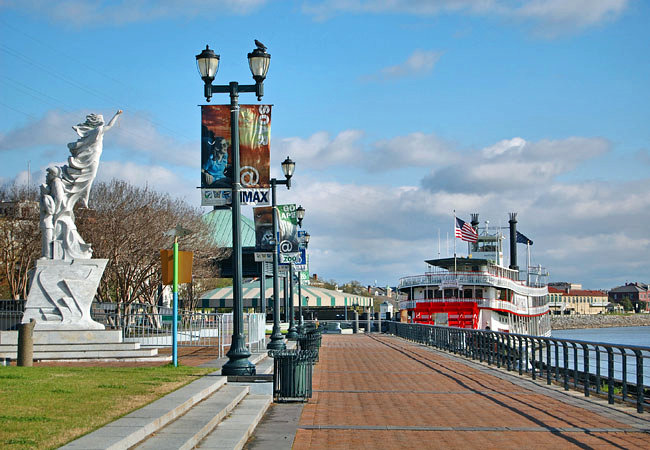
The New Orleans Museum of Art was created by sugar baron Isaac Delgado in 1911. Delgado felt New Orleans needed an art museum so it could join the ranks of America's great cities. Currently the museum houses over 40,000 objects from the Renaissance to the present. Their collections are especially strong in the areas of 18thand 19thcentury American and French furniture. It also includes a wide range of European and American art with pieces by Degas, who lived in the city from 1871-1872, Monet, Renoir, Picasso, Matisse, Gaugin, Jackson Pollack, and Georgia O’Keeffe.
As of today, however, the museum is closed because of coronavirus. The museum, however, has teamed up with Google Arts to provide virtual tours of its collections. Follow the link here.
It may not be the same as going to the museum, but it's the best way to view the collections safely.
Just a reminder: the 12th Annual DGA Family and Friends Crawfish Boil is THIS SATURDAY! That’s right, this Saturday, March 7, 2020 from 12-5 at Maison Lafitte, 402 Lafitte St. Mandeville, LA.
Now to get you properly prepared, here’s Benson to teach you all had to peel and eat crawfish.
The process is relatively simple, and a well-coooked crawfish should give even inexperienced folks little trouble. Before you start peeling, remember that crawfish boiled live typically have curled tails, such as the one in the image above. Those that were dead when they went in the boil (there’s always a few) have flat tails and mushy meat. You can toss those suckers into your pile of shells if you like.
You might have heard of the twist, pinch, and suck method of peeling crawfish. This refers to twisting off the head, pinching the tail, and sucking the head. This is the basic method we’re going to learn, although sucking the head is entirely optional. Most crotchety Cajuns suck the heads to put newcomers off their crawfish, but there’s also a culinary reason to do it and I’ll explain that at the end.
Although these colloquial terms are wildly inaccurate in terms of a crawfish’s anatomy, the two basic parts you need to know about are the “head,” the main body of the crawfish, and the “tail,” the segmented abdomen of the crawfish.
To start peeling, grasp the head in one hand and the tail in the other.
Next, twist the head and pull it away from the tail.
At this point, you can pinch the tail and pull out the meat with your teeth, but that takes some crawfish experience. Being new to peeling crawfish, you will have more success if you peel the first segment of the shell off of the tail.
You can then flip the tail over, use your thumb to pinch the tail at the base, and then pull out the meat.
Last, but not least, you can suck the head. The reason to do this is that most of the fat is in this part of the crawfish and it doesn’t always come out with the tail meat. Like crabs, crawfish fat is extremely tasty and it holds a remarkable amount of flavor. You also get a good taste of the spicy boil from sucking the head. See you Saturday!
The DGA Friends and Family Crawfish Boil is about many things. It's about bringing friends and family together. It's about listening to some awesome local music. And it's also about eating crawfish. But just what are crawfish and why do they taste so good? Let's take a look at the history of these delicious crustaceans and how they've become a culinary staple of south Louisiana.
Crawfish season runs from late February through early June. Crawfish live in the wetlands that surround the Mississippi River and its estuaries. In the centuries before European settlement in Louisiana, the crustaceans thrived in the creeks, lakes, and bayous of south Louisiana. Local native Americans collected crawfish by the bushel by baiting wooden reeds with venison and dipping them into the water. The crawfish would latch onto the meat and dangle off the reeds, providing locals with their dinner.
All the crawfish!
When the Acadians arrived in Louisiana in the 1750s, they quickly learned the value and deliciousness of this local delicacy. These French settlers, who had been expelled from Canada by the English during the Seven Years War, began incorporating crawfish into the cuisine. Over the ensuing decades, crawfish became a staple of Cajun cuisine. The Cajuns even created their own legends about the origin of crawfish, demonstrating just how important they had become in Cajun culture. According to the legend, after the explosion of the Cajuns from Canada, local lobsters followed the Acadians from the ice cold waters of the Atlantic to the Mississippi basin. When the lobsters entered the warm waters of the gulf, they shrank to their present size.
The commercial sale of crawfish began only in the late 1800s with the first recorded harvest in 1880. The crawfish, raised in the Atchafalaya Basin, resulted in a harvest of 23,400 pounds, worth about $2,140 (about $51,000 in today’s money). In 1908, the U.S. Census Bureau recorded that Louisiana produced about 88,000 pounds of crawfish per year, worth about $3,600 (about $93,000 today). The Great Depression of the 1930s drove the price of crawfish down to as low as 4 cents per pound. Technological advancements, including trucking, railroads, and refrigeration, fueled the movement of live crawfish from the rural bayou to urban centers like Baton Rouge and New Orleans. The introduction of traps and nets allowed for the collection of greater numbers of crawfish.
There are entire memes devoted to crawfish.
In the 1930s, Louisiana began to cultivate the production of crawfish on farms. Rice had long been a staple of bayou farmers. In order to gain more income, rice farmers began re-flooding their fields in order to produce harvests of crawfish in the winter and early spring. This practice soon spread across Louisiana wherever low-lying ponds and marshland could be found. The process of farming stabilized crawfish production. Before farming, the harvest in any given year depended on the water levels in the Atchafalaya Basin. Thus the market fluctuated wildly from year to year. Now with consistent water levels, farmers could control the size of the harvest and stabilize their incomes. By the mid-1960s, over 10,000 acres of crawfish farms had spread across Louisiana. In the decades since, crawfish farms have increased by a factor of twelve to approximately 120,000 acres. Louisiana accounts for 85%-95% of total U.S. crawfish production.
Hmm... crawfish
In 1960, the community of Breaux Bridge was named the crawfish capitol of the world and every year since has held yearly crawfish festival. This growth in production caused Louisiana restaurants to begin featuring crawfish on their menus. Long a staple of Cajun cuisine, crawfish étouffée became a restaurant staple. With its increasing visibility as a product unique to south Louisiana, crawfish boils became a way to celebrate the culinary traditions that make Louisiana unique. Today, the crawfish industry accounts for seven thousand jobs and 300 million dollars in revenue for the state.
The process for cooking crawfish has stayed the same over the years (and this may attest to the longevity of crawfish consumption); get a pot of water boiling (seasoned with salt and spices), add the live crawfish, let cook for several minutes. Then eat the crawfish on newspaper covered tables until you can’t eat them anymore. It’s a tradition that we look forward to upholding on Saturday March 7!
So the Crawfish Boil is obviously about the crawfish. But it's also about the music. And if you know anything about us, it's that we take our music very seriously. So for this year's Boil we're proud to welcome an old friend, Benny Turner, a returning band, Flow Tribe, and a new band the Dapper Dandies!
We're proud to welcome back Benny Turner and the Real Blues with Sam Joyner to the 12th Annual DGA Family and Friends Crawfish Boil.
Benny in action
Benny Turner is a veteran of the New Orleans, Chicago, and Texas blues scenes. His connections to the history of the blues in America run deep. His brother was legendary blues artist and Rock and Roll Hall of Famer, Freddie King. Born in Gilmer, Texas, Benny and Freddie learned guitar from their mother and uncles. Freddie gravitated towards the guitar and performing while Benny enjoyed music and spending time with the brother he admired. The family moved to Chicago in the early 1950s and as Freddie’s fame and prowess with the guitar grew, his brother soon joined his band as a bass player. By the late 1950s, Benny had toured across the United States with R&B singer Dee Clark at venues like the Apollo Theater in New York City, the Uptown Theater in Philadelphia, the Howard Theater in Washington D.C., and the Regal Theater in Chicago. Benny also enjoyed a stint in the Soul Stirrers, a touring gospel music band, and introduced the bass to gospel music, laying the groundwork for modern gospel music which is heavily reliant on the bass.
By the late 1960s, Benny returned to Chicago, playing in local bands and recording songs for the Leaner Brothers’ One-Derful and M-Pac! labels. He soon rejoined his brother, Freddie King, on the touring circuit. Alongside his brother, Benny performed with artists like Dionne Warwick, Memphis Slim, BB King, Solomon Burke, Eric Clapton, and Grand Funk Railroad. In December 1976, Freddie King passed away at the age of 42. Having lost his best friend, brother, and band mate all at the same time left Benny unable to perform. After two years away from music, famed Chicago blues artist Mighty Joe Young convinced Benny to join him on stage. Over the next few years, the two men travelled and performed together as Benny rejoined the blues scene.
By the 1980s, Mighty Joe Young had retired from touring and Benny took another big step: moving to New Orleans and becoming the bass player and band leader for blues singer Marva Wright. Wright, known locally as the “Blues Queen of New Orleans,” toured all over the world and was a staple of the French Quarter music scene. After Wright died, Benny struck out on his own. In 2011, he released, “A Tribute to my Brother Freddie King” a collection of some of his brother’s most famous songs. In 2014, he released “Journey” playing homage to his history with the blues. His latest album, “When She’s Gone” mixes some of Benny’s original songs with old blues classics. He dedicated the album to his mother, Ella, the woman responsible for his and Freddie’s love of music.
So come see this great blues artist perform at the crawfish boil. In the meantime, go to Benny’s website, read about his life, listen to some of his music, and buy an album or two in support of this legendary blues artist.
Flow Tribe
The band formed in 2004 from a group of friends from Brother Martin High School. Penot's back porch served as their primary rehearsal and hangout space. Like most high school musical ventures, the band broke up once all the members went off to college. In 2006, Hurricane Katrina brought all six men back home. They devoted themselves to rebuilding efforts, but also sought to contribute to the city's rebuilding in their own way – through their shared love of music. Early recalled that "We thought about our love of the city's music, the history, the culture. We were just a bunch of 18 and 19-year old kids, rebuilding our parents' houses during the summer... and we knew the only way we could contribute on a bigger level was with music."
The band soon reformed and hit the road. They played shows for music lovers and displaced Katrina survivors across the South. Their musical style, a blend of different New Orleans musical genres, found a wide audience amongst exiled New Orleanians and people from different parts of the country.
Since 2006, Flow Tribe have been a fixture in the New Orleans music scene while also touring across the country. They've appeared on The Real World: New Orleans in 2010. They've played at the Voodoo Music Experience, appeared on the main stage at Jazz Fest, and at just about every other major festival in New Orleans. They describe their music as "backbone crackin’ music”—a "gumbo" of funk, rhythm-and-blues, rock, bounce, hip-hop and zydeco. Flow Tribe cite Louis Armstrong, Louis Prima and Kermit Ruffins, R&B and funk classics of the 1950s, ’60s and ’70s, and hip-hop hits released by Cash Money Records in the 1990s and 2000s, as some of their influences.
They've recorded four albums: Pain Killer (2012), At Capacity Live: Live at Tipitina’s (2013), Alligator White (2014), and Boss (2017). If you want more information or examples of the Flow Tribe's music check out their website here. And make sure you come see them at this year's Crawfish boil! Dapper Dandies
Signed to Total Riot Records, the Dapper Dandies are part of a new generation of musicians bringing back the sounds of traditional New Orleans jazz. One review of their album Between St. Roch & the Channel describes the Dapper Dandies sound as "slow and boozy, yet lighthearted and romantic." The reviewer also writes, "The bass sax by Adrian Seward sounds nearly human; it’s throaty and soulfully wailing its sentiments. Jason Cash’s clarinet has a major place in the opening of “I’ve Found a New Baby” as he plays a winding tune before Aaron Lind on the guitar plays a jaunty backing to Fourmy’s melody. During the bridge, Sean Dawnson’s trumpet growls above everything else. Dawson’s horn has just a bit of a tinny echo throughout the album, which adds a nostalgic layer, as though you heard this on an original record."
With the 2020 DGA Family and Friends Crawfish Boil coming up in a few short weeks, we thought we'd offer some suggestions for things to do for our out of town guests in New Orleans.
Frenchman Street/Three Muses: If you want a taste of real New Orleans culture (and to avoid the touristy traps of Bourbon Street) head over to Frenchman Street. Jamie highly recommends going to the Three Muses, a bar/music hall. In the years since Hurricane Katrina, Frenchman Street has become the center of musical culture in the city. Go in to Three Muses, order some food (the food is as good as the music), and listen to some of the best music New Orleans has to offer. Remember to tip the band.
The Riverwalk
Aquarium/Riverwalk: Located at the foot of Canal Street, the Aquarium features a 400,000 gallon tank filled with coral reefs, sharks, and other aquatic life that populates the Gulf of Mexico. After touring the exhibits, take a few minutes and watch the sharks and turtles swim by. It’s a cool sight to see and well worth your time. The aquarium also has a stingray touch pool, sea otters, and a replica Amazon rainforest. Additionally you can walk along the Riverwalk to get to the Aquarium and watch the ships sail past the city.
Jackson Square: If you’re in the French Quarter it’s impossible not to walk around Jackson Square at some point. The square is named for Andrew Jackson, who famously defended New Orleans from the English during the War of 1812 (even though the battle took place in Chalmette and the war had ended two weeks earlier). At almost any time of day, you'll see artists selling their wares and there will be a band or two playing in front of the St. Louis Cathedral. If you want a great view of the river and the Square go across Decatur Street and climb to the stairs to the top of the little platform. It's a great place to snap a picture and enjoy the view.
The World War Two Museum
World War 2 Museum: During World War II, New Orleans was the home of the construction of the "Higgins Boat" an amphibious landing craft used in the Atlantic and the Pacific. Thanks to the efforts of Stephen Ambrose, the popular historian and University of New Orleans professor, and New Orleans business leaders, the museum, located in the Central Business District, opened in 2000 as a way to celebrate and study American involvement in World War 2. It is a must-visit for anyone interested learning more about this crucial period in American history. Read more about the museum here. Mardi Gras World: Since 1947, the folks at Mardi Gras World have designed and built the oldest and biggest floats for every Mardi Gras season. Each year they build and decorate over 500 of them. The museum offers tours that include a history of Mardi Gras in New Orleans and then take visitors to see the entire construction process. The museum is open year round as Mardi Gras in New Orleans never stops.
The white alligator
Audubon Nature Institute: The Audubon Nature Institute includes a variety of museums and facilities including the Aquarium of the Americas (discussed above), as well as Audubon Park and Audubon Zoo. Located uptown--away from the Quarter and other tourist areas, Audubon Park has over 1.8 miles of jogging paths, ancient live oak trees, picnic areas, and playgrounds. The Zoo, located within a section of the park, houses over 2,000 animals including gorillas, oranguatans, and a rare white alligator with blue eyes.
Cemetery/Swamp Tours: Due to its low elevation, New Orleans cemeteries are unique in that they generally bury their bodies above ground. Inside the famed St. Louis Cemeteryyou can find the tomb of Marie Laveau, a famed 19th century Voodoo priestess. You can also see the future tomb of actor Nicholas Cage. If cemeteries aren't your thing, then try a swamp tour. A number of different companies offer tours of the famed Louisiana bayous. Riding in a swamp boat or even an airboat. You'll get to see cypress tress covered in Spanish moss, alligators, pelicans, and other wildlife unique to southern Louisiana.
New Orleans is known for many things: Mardi Gras, voodoo, its rich history, and perhaps most importantly--food. Like any other major city, New Orleans has its share of tourist traps and great restaurants. The recommendations below will steer you towards the the city's rich and diverse culinary landscape.
Café Du Monde: We’re starting off with the obvious, but sometimes what’s obvious is best. It’s New Orleans, it’s beignets, don’t overthink it. Stroll on down Decatur Street and stop when you see the famous exterior. Go in, order the beignets, and blow powdered sugar on your friends and family. Enjoy a café au laut and watch the world go by. If you walk out of there and you’re not covered in powdered sugar, you’ve done it wrong.
Killer Poboys: Nestled in the back of the Erin Rose Bar is one of the best kept secrets of the New Orleans culinary scene, Killer Poboys. The Poboy is a traditional New Orleans sandwich consisting of some kind of protein, generally roast beef or fried seafood served on New Orleans style French bread (there’s an entire festival devoted to them). Done right, the poboy is a blank canvas for culinary innovation. And Killer Poboys does them right.
One of the many dishes available at Coquette
Coquette: Located just near the famed Commander's Palace, Coquette is an upscale neighborhood restaurant that exudes the best of New Orleans cuisine--quality local ingredients cooked simply and beautifully. Order off the al a carte menu or just order the tasting menu and put yourself in the capable hands of chefs Michael Stoltzfus and Kristin Essig.
Peche: New Orleans chef and restaurateur Donald Link has been on a roll these past few years. In 2006, he opened Cochon, an ode to Cajun cooking, located in the Central Business District. In 2013, Link decided to conquer the New Orleans seafood scene with Peche. The James Beard Foundation named Peche the Best New Restaurant in America in 2014. We've eaten there several times and the menu highlights Gulf seafood at its absolute best.
Rabbit Curry at Bywater American Bistro
Compere Lapin: After participating in Top Chef: New Orleans, St. Lucia native Nina Compton relocated to the Crescent City and opened Compere Lapin (Brother Rabbit) in 2015 in the Warehouse District. The result, which we've reviewed here, was a stunning meal that fused New Orleans with the Caribbean, culminating in a curried goat dish that you'll never forget. Bywater American Bistro: Last year, Compton opened a more casual neighborhood spot in the Bywater. Bywater American Bistro has some truly standout dishes like rabbit curry and smoked ricotta angolotti as well as a strong cocktail menu. Either of one of these restaurants are worth a visit.
Small plates at Saba
Saba: First at Shaya and now at Saba, chef Alon Shaya has brought upscale Israeli food to New Orleans. The hummus is delicious, you won't stop eating the pita, the cocktails are well-done, and the lamb kabobs are rich in flavor. Saba is a ways up Magazine Street, but well-worth a visit.
Next week we'll be back with some stuff to do when you're in New Orleans. Just a reminder: the 11th Annual DGA Crawfish Boil is March 7, 2020 at Maison Lafitte in Mandeville, Louisiana. We hope to see you there!
Just a reminder, the crawfish boil is being held at Maison Lafitte in Mandeville, Louisiana on Saturday March 7, 2020. Mandeville is on the north shore of Lake Pontchartrain. So we'll divide the recommendations depending on if you want to stay near the boil or in New Orleans. For anyone unfamiliar with the Greater New Orleans area, getting across the lake is a breeze thanks to the Causeway that cuts right across the lake.
On the South Shore, New Orleans boasts a bevy of great places to stay. We recommend that visitors make their accommodations in the city as much of the trip to Covington is on the Causeway. And if you’re going to stay in New Orleans, you may as well stay in the French Quarter (especially if you’ve never been to New Orleans before). Staying in the Quarter is a unique experience and puts you right into the action. Most of the city's tourist attractions are easily accessible and there’s always something going on nearby.
If you're looking for an AirBnB, there are plenty available inside and outside the Quarter. Prices will be lower than they would be in the previous weeks because the Boil is coming after Mardi Gras. Prices are generally similar to what you spend a nice hotel room.
The interior of the Roosevelt
Currently, our favorite hotel in the city is the Roosevelt. It's part of the Hilton-Waldorf Astoria luxury hotel chain and about 10 years ago it underwent a complete renovation that modernized the interior but kept its New Orleans charm. The renovation restored the hotel's iconic Sazerac Bar to its original 1940s decor. The Sazerac excels at cocktails in a historic New Orleans space where Huey "Kingfish" Long used to drink and meet with constituents. If you want a comfortable hotel that also exudes old school New Orleans, the Roosevelt is the place to stay.
W New Orleans - French Quarter hotel. The hotel is in a quieter part of the Quarter down on Chartres Street, but still only a couple of blocks from Bourbon.
The JW Marriott is on Canal Street, and is very close to the Quarter. Here you can be within easy walking distance of the Quarter without being surrounded by it.
Interior of the Southern Hotel
Now, we'll cover some accommodations in the Mandeville/Covington area. Covington has the standard range of visitors' hotels, but we thought it would be better to recommend some places for guests who prefer a quiet location close to the boil.
There's also the Southern Hotel in Covington. It's located in the heart of downtown Covington and houses one of our favorite local restaurants, Ox Lot 9. The restaurant also has a great bar that makes fantastic cocktails. The rooms are spacious and there's a spa located within the hotel.
Covington also has a Courtyard by Marriott and Annadele's B&B. Annadele's is a lovely plantation home near Old Covington. The grounds and rooms are charming and the restaurant is generally pretty good, especially for breakfast. We'll be back next week with restaurant recommendations. Because if you're coming to New Orleans, there's no excuse not to eat well.