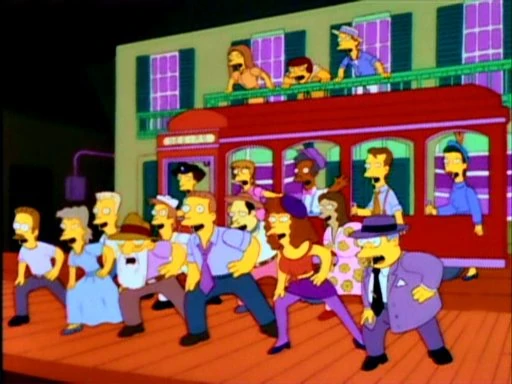
Last week, we highlighted when The Simpsons angered some residents of New Orleans with a satirical song describing the Crescent City as full of “Tacky, overpriced souvenir stores.
If you wanna go to hell you should take that trip to the Sodom and Gomorrah on the "Mississippi" New Orleans!”
Later in the show’s life, in the season 29 episode “Lisa Gets the Blues,” the Simpson family makes an unexpected detour to New Orleans. It’s a typical 2000s Simpsons entry, there’s just enough to remind you why you liked The Simpsons in the first place, but it pales in comparison to the show’s heyday. Bart buys some voodoo dolls to ward off bullies, Lisa rediscovers her love of jazz thanks to the city and a talking statue of Louis Armstrong(?), and most importantly, Homer discovers the city’s culinary landscape.
As he tells Lisa during a walk through the French Quarter, “Did you know that a man can fall in love with a city? It happens slowly at first. Then when you develop a crush, you find your love just grows and grows.” What follows is a food orgy featuring over two dozen New Orleans restaurants. Can you spot them all?
In its earliest years on television, The Simpsons generated a lot of controversy from a myriad of figures, but mostly those on the political right. Educators claimed the character of Bart, the young child who dislikes school, set a bad example for young children. In 1992, President George H.W. Bush declared, “We are going to keep on trying to strengthen the American family, to make American families a lot more like the Waltons and a lot less like the Simpsons.” Bush’s comment was remarkable in that a sitting president of the United States attacked a cartoon family for its lack of moral values. The show weathered these early criticisms and became the defining comedy of the 1990s. In the ensuing years, the show still flirted with controversy, especially in the season 4 episode “A Streetcar Named Marge” with a satirical song attacking New Orleans.
First, some context. In the episode, Marge, wanting to expand her horizons, auditions for the role of Blanche DuBois in a community theater production of A Streetcar of Desire. Her audition for the new musical version of the famed Tennessee Williams play goes poorly. The director, Llewellyn Sinclair, does not think Marge can portray the constantly put-upon Blanche until he witnesses a beaten-down Marge take a phone call from Homer. Seeing her world-weariness, he casts her in the part. Marge, struggling with a scene where she smashes a bottle and threatens the character of Stanley Kowalski (played by Ned Flanders), learns to channel her anger at Homer, who has not been supportive of her endeavors, into her performance. The episode also contains an extended tribute to the 1963 movie The Great Escape as baby Maggie orchestrates an escape from the tyrannical Ayn Rand School for Tots, where the family has dumped her while Marge pursues her theatrical dreams.
The episode is a pitch-perfect satire of both community and Broadway theater. Sinclair declares “I've directed three plays in my career and I've had three heart attacks. That's how much I care, I'm planning for a fourth.” He also points to a review of one of his earlier plays titled, "Play enjoyed by all." At one point, Marge is swinging around the theater on ropes as smoke fills the stage accompanied by a laser show. Lisa suggests that the scene is meant to show “Blanche’s descent into madness.”
Controversially, the episode also contained a song from the musical about the city of New Orleans. The lyrics are below:
Long before the Superdome, where the Saints of football play,
lived a city that the damned call home, hear their hellish Rondelet. New Orleans!
Home of pirates, drunks and whores. New Orleans!
Tacky, overpriced souvenir stores.
If you wanna go to hell you should take that trip to the Sodom and Gomorrah on the "Mississippi". New Orleans!
Stinking, rotten "vomity" vile. New Orleans!
Putrid, brackish, maggoty, foul. New Orleans!
Crummy, lousy, rancid and rank. New Orleans!
The song parodies the song “No Place like London” from the musical Sweeney Todd that described London as “a hole in the world like a great black pit/ And the vermin of the world inhabit it/ And its morals aren’t worth what a pig would spit/ And it goes by the name of London.”
A New Orleans TV critic who received the episode before it aired did not see the song as satire, however. He published the lyrics, sans context, in a newspaper the day the episode aired, prompting complaints from New Orleanians. The complaints prompted the president of Fox to release a statement saying, “It has come to our attention that a comedic song about New Orleans in tonight's episode of "The Simpsons" has offended some city residents and officials. Viewers who watch the episode will realize that the song is in fact a parody of the opening numbers of countless Broadway musicals, which are designed to set the stage for the story that follows. That is the only purpose of this song. We regret that the song, taken out of context, has caused offense. This was certainly not the intention of "The Simpsons" production staff or Fox Broadcasting Company.”
The Simpsons, for their part, threw together a chalkboard gag for the very next episode declaring “I will not defame New Orleans.” As Simpsons producer Al Jean said, “We didn’t realize people would get so mad. It was the best apology we could come up with in eight words or less.”
The controversy blew over rather quickly, especially after Bart Simpson served as the Grand Marshal of the Krewe of Tucks during Mardi Gras in 1993. Now "A Streetcar Named Marge" ranks amongst the best episodes the show ever produced, thanks to cleverness, satire, and willingness to skewer "rancid and rank" New Orleans.
After years of delays and four opening days later, the new terminal at Louis Armstrong New Orleans International Airport has finally opened. And if the interior photos and restauranteurs who have set up inside the airport give any indication, then the Crescent City finally has an airport that welcomes rather than underwhelms visitors.
The old airport terminal was 50 years of hodgepodge planning. Terminals were added, upgraded, closed, upgraded again, and renovated. With multiple security checkpoints, scattershot parking, and lackluster food options, there was little positive to say about the old airport terminal.
In the old terminal, you were lucky if you could find hot food, mixed in amongst the Hudson Newses, in any given concourse. The food options were so bad that Eater, instead of having an airport food guide like they did for other airports, just recommended visitors eat at restaurants near the airport. In the new terminal, promising options from local chefs abound. First, there are the national chains like Shake Shack and Chick-fil-A. Then there’s local spots like Folse Market from chef John Folse, Emeril’s Table from Emeril Lagasse, a MoPho outpost from Michael Gulatta, Mondo from Susan Spicer, as well as a Café du Monde so you can get your beignet fix at the airport. And good beignets, not whatever the ones they had at the old terminal were. There is also a large mural honoring the late Leah Chase inside Leah’s Kitchen.
The layout of the new terminal is much more streamlined. Instead of individual security checkpoints for each concourse, there will now be one large security checkpoint with many more lanes. There will be three concourses, A, B, and C with 6, 14, and 15 gates respectively. Like at the old terminal, there will be short term and long term parking garages adjacent to the new terminal. Additionally, there will be a separate area for taxis and rideshares to stage while waiting for fares.
Even with the new terminal opening, traffic will be a problem for the foreseeable future. Currently, there are flyovers from Interstate-10 to the old terminal. There are no such flyovers currently in place. The state did not allocate the funds to build them until well after construction on the terminal had begun. So they will not be completed until 2023. So passengers arriving on I-10 from New Orleans will have to make their way through three traffic lights on the heavily congested Loyola Drive. Passengers coming from Baton Rouge will have to navigate two stoplights and an already congested off-ramp. So while the new terminal will be a boon to New Orleans, it’s going to take longer to navigate in the short-term. At least now, there’s good beignets to soothe the souls of stressed travelers.
Now that the Saints are enjoying their well-deserved bye week, we thought it would be a good time to check in and see how their season has gone so far. In short, it’s gone pretty damned well.
According to Football Outsiders playoff odds, New Orleans has a 96.5 percent chance of making the playoffs. Additionally, they have a 91.6 percent chance of winning the NFC South. In FO’s simulations, they win an average of 12.4 games and have a 62.9 percent chance of earning a first round bye. Additionally, FO gives the Saints a 12.7 percent chance of winning the Super Bowl. 538 is similarly optimistic about the Saints’ chances, projecting them to finish 13-3 and giving them an 18% chance to win the Super Bowl, second to the New England Patriots.
What is more remarkable is that the Saints have taken a 7-1 record into their bye week after losing quarterback Drew Brees for five weeks due to a broken thumb. Under backup quarterback Teddy Bridgewater, the Saints won 5 straight games against a mixture of good (Dallas and Seattle) and bad (Jacksonville, Chicago, and Tampa Bay) teams. While Bridgewater has gotten most of the press for filling in for Brees, a closer look at the Saints reveals how the defense and special teams have helped carry the team to the precipice of the playoffs.
Once again, Michael Thomas is one of the best WRs in the NFL
Offense
Currently, the Saints rank 7th in Football Outsiders DVOA, just behind the Green Bay Packers. Even without Brees, New Orleans is 6th in offensive DVOA. Part of that is due to Bridgewater, who given his first significant playing time in years, has done everything the Saints have asked him to. He has a completion percentage of 67.7%, right in line with his expected completion percentage of 67.3. Bridgewater has also held onto the ball, throwing only two interceptions in seven games while completing nine touchdown passes.
Bridgewater, however, has had a lot of help. Wide receiver Michael Thomas currently ranks second in FO’s DYAR (Defense-adjusted Yards Above Replacement). Despite missing several games due to injury, running back Alvin Kamara is 9th in running back DYAR. The Saints have also benefitted from not turning the ball over, ranking 3rd in turnovers per drive. They have similarly benefitted from excellent starting field position, 2nd best in the league. Having elite offensive players, a shorter field, and not turning the ball over have helped the Saints weather the loss of Brees.
Saints defensive coordinator Dennis Allen
Defense
Last year, the New Orleans defense finished 11th in DVOA. This was a remarkable turnaround from years past when the Saints routinely had the worst or second worst defense in the league. Thanks to the team investing significant draft capital in defensive players and the defensive acumen of coordinator Dennis Allen, New Orleans currently sits 6th in defensive DVOA, halfway through 2019. The Saints are 8th in opposing points per drive and 6th in plays per drive. They have been similarly balanced in stopping the run and passing games. They rank 11th against the pass and 7th against the run.
In two of the five games without Brees, the defense held its opponents to 10 points or fewer. Additionally, garbage time touchdowns by the Bears and Buccaneers inflated the Saints points allowed per game numbers.
Lutz!
Special Teams
The real surprise for the Saints has been the special teams. In recent years, New Orleans special teams, similar to their defense, languished near the bottom of the league. Under new special teams coordinator Darren Rizzi, the Saints rank 12th in special teams DVOA. Kicker Wil Lutz has been just above average this season (0.9 expected points added), as has punter Thomas Morstead (1.1 points) but the real standout has been the punt return team with 6.5 expected points added, best in the league. The kickoff coverage has been especially disappointing, however, costing the Saints -6.7 points.
So while Bridgewater and Saints head coach Sean Payton have received much of the credit for the Saints ability to withstand the loss of Brees, the defense and special teams have held up their end of the bargain as well.
To understand the scope of the challenge the Rebel Alliance faced, we need to first look at their opposition: the Galactic Empire. The Empire had the funding and resources available to construct two Death Stars, build and maintain a massive fleet of star destroyers, thousands of TIE fighters, and feed and cloth countless snow, scout, and stormtroopers. It had innumerable bases and research facilities across the galaxy. The bureaucracy and infrastructure required to keep the Empire functioning is truly mindboggling.
But when we look at it more closely, we can see how the Empire maintained this massive military industrial complex. There were thousands of star systems under its control, providing access to nearly unlimited raw materials. Mustafar, the volcano planet fromRevenge of the Sith,had extensive mining facilities to extract minerals from the planet’s lava supply. The planet of Kamino was known for its cloning facilities, providing thousands of clone and later storm troopers to fill the ranks of the Empire’s armies. Coruscant, the Imperial capital, came to take over an entire planet, devoted to maintaining the Imperial bureaucracy. Emperor Palpatine kept the local systems in line by maintaining the apparatus of the Galactic Republic when he came to power. After all, why destroy an entire governing system when you can just shift its priorities a bit?
In order to defeat the Empire, the Alliance needed a similarly large and complex organization. The beginning of the original trilogy undersells the size and scope of the Rebellion. In A New Hope, they are a relatively small force both in numbers and ships. They send maybe 30 attack fighters against the Death Star at the Battle of Yavin. Luke Skywalker is there for about 10 minutes before they put him in an X-Wing and send him off to die. The Empire Strikes Back features a stronger Rebellion, armed with numerous transport ships, an ion cannon capable of disabling a star destroyer, and a larger stable of fighters. While Rogue Group battles the invading Imperials, another group of pilots escorts the transports off of Hoth. They even have a medical frigate. Return of the Jedi finally reveals the full power of the Alliance. Leia speaks of the Alliance assembling for its attack on the Second Death Star, suggesting they operate in a more fragmented structure than we have previously seen. They gather the full power of their fleet that, despite Admiral Ackbar’s protestations, proves capable of holding its own against Imperial Star Destroyers.
Ships don't come cheap
Now how did they pay for all of it? A fleet of star ships requires repairs and equipment. Soldiers need food and weapons. While it is conceivable that the Rebel troops are eschewing pay, they still have to have supplies. Getting those supplies becomes a lot easier when you can pay for them in cash rather than vague promises of Galactic equality. Perhaps they stole from the Imperials and others? Stealing from the Empire makes sense, but as a rebellion to restore peace and justice to the Galaxy, stealing from suppliers is bad in both the short term—those people are going to want their stuff back—and long term—they’ll shoot you the next time they see you.
Spies and other collaborators don’t work for free, so they need compensation. And not just any kind of compensation, but cold hard cash. You can preach all of the high minded idealism about freeing the Galaxy from tyranny that you want, but if you want some Bothan spies to risk their necks (do Bothans have necks?) you need to fork over the dough. And as we’ve seen the Rebellion has plenty of cash on hand. As Han Solo readies to leave Yavin 4 inA New Hopehe’s packing up his 17,000 credits—not including any bonuses for rescuing Princess Leia and providing the Alliance with the plans to the Death Star. Rebellions are a cash-only business.
Likely the Rebellion relied on several different sources of funding. First, the Alliance has some very wealthy benefactors. Princess Leia’s family, the Organas, was the ruling family of Alderaan, with the ample access to wealth that royalty provides. Additionally the Rebellion drew much of its leadership from the nobles of Alderaan and sympathetic senators (themselves quite rich). Their prosperous positions gave the Rebels access to large revenue streams. While these people contributed their time and effort to the struggle against the Empire, they likely opened their wallets as well. This well of funding, however, may well have dried up after the destruction of Alderaan. With so many supporters and leaders killed, including Leia’s father, a significant amount of the Rebellion’s financial backing probably died in the holocaust that enveloped the planet—access codes and passwords to hidden bank accounts crying out in terror.
Perhaps the Alliance managed to survive this catastrophe with smart financial planning. Maybe they diversified their assets and kept them in banks and other repositories where they could have easy access, even if the account holder died, or her planet was blown up by an angry Imperial administrator. Even if they didn’t keep all their money hidden under their space mattresses, Alderaan’s destruction likely put a dent in the Rebellion’s finances.
Bye-bye to the source of rebel funding
According to Wookiepedia, the Rebels also sold “Alliance War Bonds.” Wookiepedia describes them as low yield, long term bonds issued by the Rebels. Investors could buy bonds from the Rebellion in exchange for repayment five to twenty five years after the conclusion of the Galactic Civil War. They, however, promised investors only a small profit on their return. These bonds made for a lousy investment and likely the only people who purchased them were either taken in by their smooth-talking neighborhood Alliance salesman or their sympathies for the Rebels. Surely the Galactic stock exchange offered better and more profitable alternatives.
Wookiepedia also tells us that the Alliance issued its own form of credits (the galactic currency) that could be swapped at a 25-1 exchange rate for Imperial credits. Such a high exchange rate shows how little the rest of the Galaxy valued Alliance currency. Additionally the Rebellion likely never issued enough credits to circulate and become a viable alternative means of exchange. The money is only as good as those who issue it. Which currency had the better long term future: the Galactic Empire or the Rebel Alliance?
The last and most viable option for the Rebels would have been to borrow from the InterGalactic Banking Clan(IGBC). The Clan had already shown its willingness to support rebel causes by allying itself with Count Dooku and the Separatist movement during the Clone Wars. They had helped fund the creation of a droid army that pushed the Republic to the brink of defeat. They had also earned the scorn of the Emperor. Palpatine had the banking clan’s chairman killed by Darth Vader on Mustafar at the end of the Clone Wars. The IGBC and the Alliance seem like natural allies.
The IGBC could get revenge on the Emperor by loaning money to the Rebels. They could also charge some exorbitantly high interest rates (rebellions aren’t known for paying back their debts) and make a profit, regardless of the outcome. If the Rebels triumphed over the Empire, then the IGBC had financed the winning side. If the Alliance lost, the IGBC could just take their profits and move on. This deal also makes sense from the Alliance’s perspective as well. Who better to go to for cash than a banking clan with a grudge against the Empire and a history of fomenting rebellion?
So there you have it, the answer answer to the question that has plagued precisely no one regarding the funding of the Rebel Alliance in Star Wars.
When talking Sazerac in New Orleans, things can get a little confusing. First, there’s the Sazerac cocktail, comprised of a combination of cognac or whiskey, absinthe, Peychaud’s bitters, and sugar. Then there’s Sazerac, the rye-whiskey brand. And finally, there’s the Sazerac Company, makers of the Sazerac rye-whiskey. The Sazerac Company, for its part, doesn't just own Sazerac whiskey. Rather it is one of the largest spirits companies in the United States. Currently it owns nine distilleries including Buffalo Trace Distillery, W.L. Weller bourbon, Southern Comfort and a number of other brands. They also produce Pappy Van Winkle and Old Rip Van Winkle bourbon. In total, the company owns or produces over 300 different types of spirits.
The company was founded after Thomas H. Handy bought a bar called the Sazerac Coffee House in New Orleans in 1869. The bar had been named after the Sazerac cocktail, created in the mid-1800s by Antoine Amedee Peychaud, an immigrant from Saint Domingue (modern-day Haiti). Peychaud sold Sazeracs out of his pharmacy on Royal Street in the French Quarter in 1838. Peychaud had created his own bitters—an alcoholic liquid flavored with herbs or other botanical products to add bitterness to cocktails—that are now an essential part of the Sazerac cocktail.
At the beginning of October, the Sazerac Company opened the Sazerac House in a formerly dilapidated building on the corner of Canal and Magazine Streets. The multi-level museum, located just blocks away from the original Sazerac Coffee House, is more than just a bar. The first floor houses a 500 gallon still, five feet across, that makes a barrel of Sazerac whiskey a day. The second floor has digital bartenders and demonstrations about how to properly make a Sazerac cocktail. The third floor features the history of the cocktail in New Orleans. With walls covered in cityscapes of early 20th century New Orleans, visitors see the entire process of cocktail production—from the port of New Orleans all the way to the glasses of bar patrons across the city.
If you want to make your own Sazerac at home, Sazerac House has a recipe for you.
INGREDIENTS
1.5 oz Sazerac Rye Whiskey
1 sugar cube
3 dashes Peychaud’s Bitters
.25 oz Herbsaint
Lemon twist
PREPARATION
Pack an Old-Fashioned glass with ice. In a second Old-Fashioned glass, place a sugar cube and add three dashes of Peychaud’s Bitters to it. Crush the sugar cube. Add 1.5 oz Sazerac Rye Whiskey to the glass with the Peychaud’s Bitters and sugar. Add ice and stir. Empty the ice from the first glass and coat the glass with .25 oz Herbsaint. Discard the remaining Herbsaint. Strain the whiskey / bitters / sugar mixture from the glass into the Herbsaint coated glass and garnish with a lemon peel.