Tuesday, October 23, 2018

Major League Baseball Players from Louisiana: Hitters

            The World Series begins tonight with the Los Angeles Dodgers facing the Boston Red Sox at Fenway Park in Boston. The Dodgers last won the World Series in 1988 and Boston won most recently in 2013. The matchup involves two of the oldest teams in Major League Baseball: the Dodgers were founded in 1883 in Brooklyn and the Red Sox were established in 1901. The Red Sox have won eight World Series titles and the Dodgers have won six. Both teams led their respective leagues in runs scored. Both have outstanding left-handed starters—Chris Sale for Boston, Clayton Kershaw for the Dodgers. The Red Sox beat a 100-win Yankees team and 103-win Astros team to reach the Series. The Dodgers defeated the Atlanta Braves and Milwaukee Brewers. 

            Looking for a local angle for the World Series, we looked over the rosters of the Red Sox and Dodgers and found that neither team had a player from Louisiana. Neither team even had a player who attended LSU or another Louisiana institution of higher education. So instead, let’s take a look at famous baseball players from Louisiana. This week we’ll look at hitters and next week we’ll come back and take a look at some famous pitchers.


            Let’s start with some general facts before delving into the background of the some of the players: 

·     There have been 256 players from Louisiana who have taken an at-bat in Major League Baseball.  

·     The first two players: John Peters and Dan Collins played in 1874. 

·     Fourteen players from Louisiana took an at-bat in the majors in 2018. 

·     Over the course of baseball history, 71 players from New Orleans have made the majors. 

·     Shreveport is second with 26. Baton Rouge has sent 18 players, followed by 12 from Lafayette and 11 from Lake Charles. 

Mel Ott is the career leader in wins among replacement (WAR) by a player from Louisiana. His 107.8 career WAR rank 22nd all time. Born in Gretna, Louisiana in 1909, Ott made his first appearance for the New York Giants in 1926. He batted left-handed and threw right-handed. In his career, Ott made eleven consecutive All-Star teams and was the first National League player to reach 500 career home runs. For his career, Ott had a .304 batting average, .414 on-base percentage, and .533 slugging percentage. His 511 home runs rank 25thall time. He retired in 1947 and was elected to the Baseball Hall of Fame in 1951.   

Albert Belle and his corked bat 

Now let’s look at some other standout players from Louisiana. 

·     Tommy Harper, a speedy outfielder from Oak Grove, led the league in stolen bases in 1969 and 1973 with 73 and 54 steals. 

·     Albert Belle, a power hitting outfielder from Shreveport, hit 381 home runs in his eleven year career. In 1994, Belle was suspended for using a corked bat (corking a bat is a process of stuffing the inside of a bat with cork or a lighter substance than is allowed by the rules. Corking a bat makes it lighter and easier to swing.) Belle then convinced a teammate, Jason Grimsley, to climb through a ceiling panel in order to steal his corked bat out of the umpires’ dressing room and swap it with a different one. Belle had a reputation for destroying clubhouse equipment and being rude to teammates and the media. 

·     Former MLB shortstop and New Orleans native Ron Washington managed the Texas Rangers from 2007-2014. In 2010 and 2011, Washington led the Rangers to the World Series, but lost to the San Francisco Giants and St. Louis Cardinals. He was only the third African American manager to lead a team to the World Series. His 664 career wins are the most in Rangers history. 

Next week, we’ll finish up our look at Louisiana’s baseball history by looking at some famous pitchers. 

Tuesday, October 16, 2018

The History of Bananas Foster

Bananas Foster 

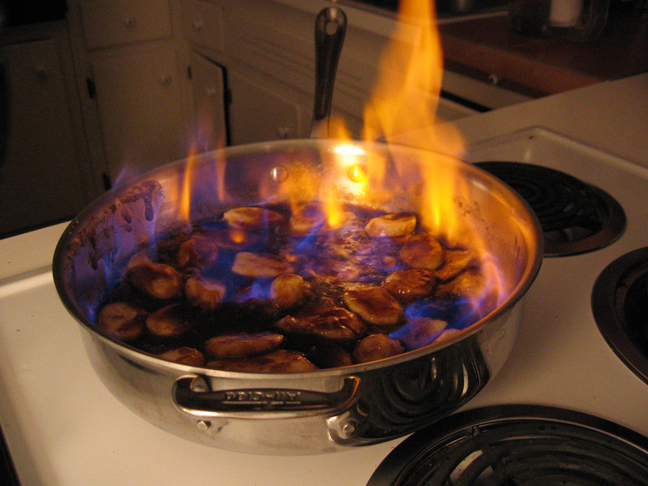
            Bananas Foster is emblematic of New Orleans. The dish is a combination of New Orleans' long history as a port city and its culinary ingenuity. The famous dessert consists of bananas and vanilla ice cream accompanied by a sauce made from butter, brown sugar, cinnamon, dark rum, and banana liqueur. The butter, sugar, and bananas are sautéed in a pan. Then the alcohol is added and ignited. The bananas and sauce are then put into a serving vessel and served with vanilla ice cream. The ignition of the alcohol, known as a flambé, comes from the heated alcohol vapors and burns off the alcohol in the dish while leaving behind a slightly burnt flavor. The flambé is an attractive table-side presentation at New Orleans restaurants, including Brennan’s, where the dish originated. 

            Ella Brennan, the famed New Orleans restauranteur who was managing Brennan’s Restaurant in 1951, created the famous dessert on a whim. The restaurant’s owner, Owen Brennan, was hosting a dinner in honor of Richard Foster, the chairman of the New Orleans Crime Commission. As a result, Owen told Ella to whip up a new dessert for their honored guest. She ran back into the kitchen and grabbed some bananas that were laying around. Inspired by a caramelized banana dish her mother would make for breakfast, Ella sautéed the bananas in a pan. Also inspired by the Baked Alaska at nearby Antoine’s, Ella decided to flambé the bananas. The dessert was a hit that night and has been on the menu at Brennan’s ever since.  

Flambé at work 

            It is fitting that Ella Brennan selected bananas as the centerpiece of her new dessert. The banana has a long and troubled history in New Orleans. Bananas were not always America’s favorite fruit. Until the 1870s, fresh fruit was difficult to come by. America lacked the infrastructure to move fresh fruit around the country before it spoiled. By the late 1800s, however, the growth of railroads, refrigerated railroad cars, and genetic engineering led to fruit to become a staple of the American diet. New Orleans was at the center of the burgeoning fruit industry. As a large port on the Gulf of Mexico, the Crescent City was the quickest entry for fruit into the United States. Big fruit companies like Standard Fruit and Cuyamel Fruit Company set up their headquarters in New Orleans. 

            Samuel Zemurray, president of Cuyamel, was the driving force of the banana industry in New Orleans. Zemurray began his career by seizing upon the untapped potential in the banana market—ripe bananas. As the banana market in New Orleans grew, importers discarded ripe bananas, fearing that they would spoil before they reached markets across the country. Zemurray saw an opportunity; he bought up the ripe bananas, arranged a delivery deal with a local railroad, and made a fortune. Zemurray soon bought banana plantations, banana boats, and anything and everything related to banana production. His Cuyamel company quickly became one of the nation’s largest and most powerful companies. 

Sam the Banana Man 

            Zemurray’s activities at Cuyamel and later when he ran the United Fruit Company reveal the dark side of the banana business and its history in New Orleans. Workers in New Orleans and on banana plantations in Latin America faced brutal working conditions. Because of the time sensitive nature of harvesting, laborers worked long hours for little pay. They suffered from tropical diseases and were regularly exposed to harmful pesticides. Banana farming also drained the land of nutrients and brought in new destructive fungi, leading banana companies to buy up and discard greater and greater amounts of land. It also angered locals who saw more and more of their land handed over to big corporations and subsequently destroyed. Additionally, Zemurray routinely paid off local governments, seized land from natives, and engaged in other morally questionable business practices. 

            In 1910, Miguel Dávila came to power in Honduras. He had promised that Honduran people that he would make banana companies like Cuyamel pay their fair share of taxes. For years, companies like Cuyamel, exported bananas and other natural resources from Honduras without paying any taxes. Success in the volatile banana business, Zemurray argued, relied on bribes and kickbacks to the Honduran government, keeping the cost of business low and the profit margins high. As a result, the Honduran government had to borrow large sums of money from American banks. Dávila negotiated a treaty with the United States that would place agents of the J.P. Morgan company in Honduran customs houses, collecting taxes that would pay off Honduras’s debts. 

Workers unloading bananas

            Zemurray, not wanting to pay taxes and fearing the loss of his business, decided to orchestrate a coup against Dávila, led by former president Manuel Bonilla. He provided guns, money, and even bought and outfitted a decommissioned US Naval warship.  Secretary of State Philander Knox warned Zemurray not to interfere in Honduras, but Zemurray proceeded with the coup anyway. When Bonilla came to power, he voided the deal with the U.S., protected Zemurray’s interests, and threw Honduras back into crippling debt. 

            Zemurray did all of this for control of the banana market. Who knew such a little fruit could have such lasting consequences? 

Tuesday, October 9, 2018

New NOLA Airport Terminal

            Louis Armstrong International Airport is … not great. For as much as New Orleans prides itself and relies on tourism, the city’s airport offers an underwhelming welcome to visitors to the Crescent City. 

            The Louis Armstrong International Airport began commercial service in May 1946 under the name Moisant Field. The airport was named after a daredevil pilot, John Moisant, who died in 1910 in a plane crash on the land that later became the airport. In 1959, a new terminal building replaced the large airplane hangar that served as the terminal. This 1959 construction serves as the shell of the current terminal building. In 1974, the airport renovated and opened Concourses A (now closed) and B. Concourse C opened in 1992 and was renovated in 2007. Concourse D opened in 1996 and was expanded in 2011. Following Hurricane Katrina, the airport underwent extensive renovations as New Orleans sought to bring the tourist trade back to the city. Further renovations added a new rental car facility and upgraded the terminal’s interior as part of the city’s bid to host of the Super Bowl in 2013. 


            Even with the renovations, the airport has suffered from some serious issues. For one thing, there is no place to eat in the airport. Post 9-11, major airports like Dallas-Fort Worth, LAX, Houston, and Atlanta have made concerted efforts to improve the quality of food and amenities inside their airports. In its recommendations for dining at Armstrong, Eaterhas lengthy list of places within 20 minute drive but few within the airport itself. Next May, however, the food options should improve at Louis Armstrong. On May 15, 2019, the airport will open its new terminal that has been under construction since 2013. It will feature new dining options from New Orleans chefs Leah Chase, Susan Spicer, and Emeril Lagasse. 

            The new terminal will be the capstone to an unprecedented decade for the New Orleans airport. Four out of every five passengers who come into or out of Louisiana fly through Armstrong. In recent years, the airport has added two direct flights to Europe: to London on British Airways and to Frankfurt on Condor. Airport traffic has increased by over 60% making Armstrong the third fastest growing airport in the country. The new terminal will be the first complete terminal replacement at an American airport since Indianapolis in 2008. The airport had a record number of passengers in 2017, over 12 million, nearly double the post-Katrina low of 6.2 million in 2006. 


            The airport was the centerpiece of former mayor Mitch Landrieu’s administration. In 2011, Landrieu began agitating for a new airport. His efforts followed 30 years of failed alternatives that included constructing a new airport on the north shore of Lake Pontchartrain, building a new airport in New Orleans East, renovating the current terminal, and a host of other proposals. The airport board hired a consulting firm that studied four different options: refurbishing the current terminal for the cost of $595 million, or building a new terminal in three different locations: on the site of the current one, west of the existing terminal, or north. Landrieu and the airport board settled on the fourth option, constructing a new terminal north of the current one for $650 million. They settled on the northern option due to its proximity to Interstate 10. This massive financial outlay came in spite of the fact that the airport had just spent $300 million renovating the existing terminal as part of its bid to host the Super Bowl in February 2013. 

            That wasn’t the only issue that arose during the airport construction. The cost of the project, originally estimated at $650 million, has ballooned to $1.3 billion. The cost overruns came from several areas. First, the original design of the terminal was too small. The airport board decided to add five more gates in anticipation of growing demand causing the cost to spike. Interstate flyovers, that would take traffic directly from the interstate to the airport, had not been factored into the original cost, adding an additional $150 million at minimum. Shifting soils necessitated the construction of new sewages pipes and pushed the opening of the terminal from 2018 to 2019. The new long-term parking lot will also not be ready by the time the airport opens meaning that shuttle services will have to transport passengers to and from the lot. Rental car services will also rely on shuttles. Currently, the rental car facility is in walking distance of the terminal. This will not be the case in 2019 with the new terminal. 


Additionally, the new flyovers have not been built yet and won’t be ready until 2023 at the earliest. This was the result of poor planning by the airport board as they did not factor traffic into their original plans for the new terminal. So when the new terminal opens, passengers arriving on I-10 from New Orleans will have to make their way through three traffic lights on the heavily congested Loyola Drive. Passengers coming from Baton Rouge will have to navigate two stoplights and an already congested off-ramp. The current flyovers take only five minutes from the interstate to the airport. Until the new ones are constructed, it will take a lot longer. 

At a ceremony marking the construction of the new terminal, Landrieu promised that the airport “will be the economic engine that drives the future.” Whether that is in 2019, 2023, or sometime later remains to be seen. 

Tuesday, October 2, 2018

Saints Quarter-Season Check-In

The Saints season is going well

            After four games, the New Orleans Saints have a record of 3-1. They have a half game lead over the Carolina Panthers in the NFC South. Since the Saints are a quarter of their way through the season, we thought it would be a good time to check in with how their season has gone so far. We’ll be looking at three numbers to be excited about for the rest of the season and two numbers that should concern Saints fans. 

Three Numbers to Get Excited About 

66.9%

            According to Football Outsiders, the Saints have a 66.9% chance of making the playoffs after four weeks. That is the fifth highest percentage in the NFL, behind the Rams, Chiefs, Bears, and Ravens. Football Outsiders also gives New Orleans a 5.3% chance of winning the Super Bowl. Currently the Saints are third in the NFC behind the undefeated Rams and the 3-1 Bears. The NFC South is always a competitive division, but the Falcons are 1-3 after two close losses and the Buccaneers have lost two games in a row after beating the Saints and Super Bowl champion Eagles to open up the season. The Panthers have already lost to the Falcons and barely beat the Cowboys. The road to the playoffs is open for the Saints. 


95.5% 

            Saints quarterback Drew Brees has thrown 44 passes to wide receiver Michael Thomas. Thomas has caught an NFL-leading 42 of those passes for a 95.5% catch rate. He is averaging 11.3 yards per game and 10.5 yards per reception. Thomas has already amassed 445 yards in just four games, putting him on track for nearly 1,800 yards receiving. With quarterback Drew Brees completing 75.8% of his passes with 8 touchdowns and 0 interceptions, Thomas should get plenty more opportunities as the season goes on. 

137 

            2018 is just like any other season in the history of the Drew Brees-Sean Payton partnership. The Saints are second in the NFL with 137 offensive points, only three behind the league leading Rams. New Orleans is averaging 34.3 points per game. Week Two’s game against the Browns was the only game where the Saints did not score 30 points. Running back Alvin Kamara has 661 yards from scrimmage over the first four games with six touchdowns. Kamara is averaging 68.8 yards on the ground and 84 yards through air per game. With the return of Mark Ingram next week, there’s little reason to suspect that the Saints offense will slow down anytime soon. 

Age 39 and Brees is cruising along 

Two Numbers to Be Concerned About 

121 

            While the Saints have scored 137 points, they’ve also allowed their opponents to score 121 points, 4thworst in the league. Opposing teams have averaged 30.3 points per game. And, apart from the Falcons, the Saints have not exactly faced a murderer’s row of offenses. Tampa Bay, Cleveland, and the Giants are not anyone’s idea of the best offenses in the NFL. And the future does not bode well as the Saints have the Vikings, Rams, Bengals, Eagles, and Falcons in a five week stretch coming up. Unless the defense takes a dramatic step forward, New Orleans could be in trouble. 

45.7% 

            The New Orleans defense has allowed opponents to convert 45.7% of their third downs—fifth worst in the NFL. This is part of a larger trend of the Saints defense being unable to force opponent’s offenses off the field. They’ve allowed 39.26 yards per drive, 3rdworst in the league. And most troublingly, New Orleans has struggled to create turnovers. So far this season, they’re last in the league in creating turnovers. Last season, the Saints ranked 9thin the NFL. This inability to create turnovers or stop opponents on third down has given opponents more opportunities to score and has put more pressure on the offense to keep scoring. 

Tuesday, September 11, 2018

Bye Bye Baby Cakes


           A few weeks ago, we explored the history of the original New Orleans Pelicans—the minor league baseball team that played in New Orleans for over 75 years. While the Pelicans left for good in 1977, baseball fans in the Big Easy only had to wait until 1993 to get a new professional team—the Zephyrs. The Zephyrs, who came to New Orleans from Denver, set up shop first in New Orleans at Privateer Field, home of UNO’s baseball team, before settling at the Shrine on Arline in Metairie in 1997. In 2017, they changed their name from the Zephyrs to the Baby Cakes. Last week, the Baby Cakes that they would be leaving New Orleans for a new stadium in Wichita, Kansas, once again leaving baseball fans in New Orleans without a team for the foreseeable future. 

            Last Thursday, Wichita Mayor Jeff Longwell announced that the city would construct a brand new $73 million stadium with the Baby Cakes as its tenant. It is not clear when the stadium will be complete and the move still requires the approval of Minor League Baseball and the Pacific Coast League. The earliest the team could move would be after the 2019 season. The Baby Cakes’ lease at the Shrine on Airline runs through 2021, but the team hopes to negotiate an early exit. 

The Shrine on Airline

            The Baby Cakes are the Triple-A affiliate of the Miami Marlins. It is unclear with the move to Wichita whether they will retain that affiliation or switch to another franchise. The Baby Cakes ranked 21stout of 30 Triple-A teams in attendance in 2017. Additionally, the team plays in the 16 team Pacific Coast League, requiring an extensive amount of travel west. Geographically, the league extends from California to Tennessee and Washington to Louisiana. Unlike major league teams who travel by plane, Triple-A teams travel by bus. A relocation to Wichita will make travel quicker and cheaper for the Baby Cakes. Relocation is also a reality of life in minor league baseball. Mid-size cities like Wichita build new stadiums and lure teams away from their current homes. Then the new abandoned city goes looking for a replacement, setting in motion a big game of musical chairs. In the end, at least one city winds up with a stadium, but no team. The Zephyrs had spent 37 years in Denver and 53 years in Kansas City before settling in the Big Easy. In terms on minor league franchises, that is a remarkable run of stability. 

Mayor Longwell said in his press conference that he does not expect the team to retain the Baby Cakes moniker. The name, which came into existence in 2017, has never been particularly popular. In 2016, the then-Zephyrs undertook an effort to rename the team to something more fitting to New Orleans’ culture. The Zephyrs had been the team’s name in Denver and had few ties to Louisiana—apart from sharing the name of a famed rollercoaster at Pontchartrain Beach. Name choices included the Baby Cakes, Crawfish, King Cakes, Night Owls, Po’boys, Red Eyes, and Tailgators. The team eventually selected Baby Cakes as the new name. The name was derived from the plastic baby found in Mardi Gras king cakes. Many fans, however, were confused or annoyed by the name since no one in New Orleans refers to a king cake as a “baby cake.” Additionally, the team logo and mascot are creepy looking. 

That thing is creepy looking

The Advocate reported that a group of New Orleans businessmen is interested in buying a Double-A franchise in the Southern League and relocating it to New Orleans. The Southern League is much more geographically narrow than the Pacific Coast League with teams in Tennessee, Alabama, Mississippi, and Florida. It is unclear which team the New Orleans group would be interested in purchasing or whether any Southern League owner is willing to sell. Additionally, the state would likely have to pay for some upgrades to the Shrine on Airline to entice a team to move. For right now, however, the fate of professional baseball in New Orleans remains unclear. 

Tuesday, September 4, 2018

2018 Saints Season Preview

The Saints had a lot to celebrate last year 

            In 2017, the New Orleans Saints went 11-5 and captured the NFC South title. They beat the Carolina Panthers 31-26 in the wild card round before falling to the Minnesota Vikings in a heartbreaking last second loss, 29-24. Despite the disappointing end to the season, the 2017 was the Saints first trip to the playoffs since the 2013 season. After 2013, the Saints slipped into a period of sustained mediocrity, posting a 7-9 record for three straight seasons. 

            Since the NFL season begins this weekend, it’s time for a Saints season preview. Instead of breaking down the Saints offense, defense, and special teams individually, we’ll do things a little differently this year. Rather than make a straight-up prediction that will likely be wrong, we’ll look at three reasons why the Saints could be better than their 11-5 record and 3 reasons why they could be worse. 

Sean Payton in mid-season scowl form 

Three Numbers that Suggest the Saints Might Improve 

62.3: Football Outsiders tracks a statistic called adjusted-games lost. It is a measure of many games a team lost due to injury from their starters. Last year, the Saints lost 62.3 games on defense due to injury. That number was the second highest in the league. Research has shown that injury luck tends to even out over time. So when a team loses a lot of players to injury one year, they’re likely to regress towards the league average. Considering the Saints posted a -7.9% DVOA, good for 8thin the league, there seems to be even more opportunity for the Saints defense to improve or at least not give back some of their defensive gains.    

24.9: Football Outsiders has another statistic that measures the average age of players on each team. Instead of simply averaging the ages of all the players on the roster, FO calculates a team’s age based on the number of snaps played by each player. In 2017, the Saints defense snap-weighted age was 24.9, second youngest in the league. While there isn’t a direct correlation between youth and effectiveness, you'd rather be young and effective than old and effective. Additionally, the youth of the Saints defense suggests that there's further room for improvement. Last year’s big contributors, Sheldon Rankins, Marcus Lattimore, and Marcus Williams, are still young, but now have another season of NFL play under their belts. 

6: Head coach Sean Payton and quarterback Drew Brees arrived in New Orleans in 2006. In the twelve seasons since, the Saints have averaged 6thin Football Outsiders offensive DVOA. In the intervening years, a whole host of players have come and gone—Jimmy Graham, Marques Colston, Jahri Evans, Duece McAllister, Pierre Thomas, and others. Yet Brees and Payton have continued to hum along. The lowest they ever ranked in offensive DVOA was 12thin 2007. Since 2011, the Saints have never ranked worse than 9th. In other words, as long as Payton and Brees are together, the Saints don't have much to worry about on offense. 


You know who this is. 

Three Numbers that Suggest the Saints Might Decline 

23: In 2016, the Saints ranked 31st in defensive DVOA. In 2017, they ranked 8th. The study of such large improvements in the history of the NFL suggests that the Saints will give some of this massive gain back. Baseball sabermetrician Bill James called this the “plexiglass principle.” In mathematics, it’s called regression to the mean. In order for the Saints to have made such a massive defensive improvement, a lot of things had to go their way. Last season, they had a superstar season from defensive end Cameron Jordan. They hit on a number of defensive draft picks in 2016 and 2017 including cornerback Marshon Lattimore, safety Marcus Williams, safety Vonn Bell, and defensive tackle Sheldon Rankins. There’s simply no guarantee that all of these players will be healthy or continue to be effective in 2018. More likely, something will happen to one or more of them that will hurt the Saints efforts to repeat their defensive performance. 

6.1: Alvin Kamara was an offensive sensation in his first season in New Orleans. He had an astonishing 13 touchdowns and 1554 yards from scrimmage in only 201 touches. He averaged an insane 6.1 yards per carry. Cam Newton was second in the NFL with 5.4 yards per carry and running back Dion Lewis was third with 5.0 yards. As Bill Barnwell has pointed out, eight running backs have averaged more than six yards per carry in a given season. They never did it again in their careers. In the next season, none even made it to five yards per carry. In other words, even though Mark Ingram is suspended for the first four games, Kamara won’t be this efficient again. And that could hold the Saints offense back. 

23: Drew Brees only threw 23 TD passes in 2017. While the Saints also had 23 rushing touchdowns, Brees had the fewest TD passes since 2003 when he played for the Chargers. His 4,334 passing yards were his fewest since 2005, his last season in San Diego. While Brees remained incredibly effective, especially for a 38 year old passer, any sign of slippage is concerning. NFL history tells us that there’s no long slow decline phase for quarterbacks this late in their careers. Rather when the end comes, it comes quickly. Maybe Brees will throw for another 5,000 yard season with 30 TDs again. Or maybe Brees is closer to the end than anyone would like to admit. 

Tuesday, August 28, 2018

City Park

The Carousel at City Park 

          City Park is a 1,300 acre public park in New Orleans. The park has long been a staple of life in New Orleans and has a long and rich history. The park’s collection of live oak trees are one of its one most distinctive features. They are over six hundred years old and have a history dating back before the creation of the park. In the late 1700s and early 1800s, male residents of New Orleans would engage in duels in the area that later became the park. At the time, the oaks sat outside of the city’s population centers in the French Quarter and American Sector (the present day Central Business District). They provided a private location for the city’s gentlemen to settle affairs of honor. Over time, the area became known for the “Dueling Oaks” a pair of oak trees where men frequently met to duel. One of the oaks, however, fell over during a hurricane in 1949.

            In 1854, the 4thDistrict Court of the City of New Orleans declared a plot of land left to the city by a plantation owner named John McConogh to be a public park. The park remained largely undeveloped until the late 19thcentury. In 1891, the City Park Improvement Association was founded and officially gave the park its name. The Improvement Association was part of a broader reform movement in the late 19thand early 20thcenturies that sought to create and preserve open spaces within cities. Pollution from factories and other industries had made cities unpleasant places to live. Dirty air and dirty water sickened residents. Middle and upper-class reformers stressed the need for free, public, and open spaces for residents to enjoy the outdoors. Parks also served as gathering places for public concerts, rallies, and meetings. 

The Oak Trees 

            By the early 20thcentury, City Park had installed a carousel, miniature train, golf course, and a racetrack. The Isaac Delgado Museum of Art, later the New Orleans Museum of Art, opened in 1911. The Improvement Association continued to buy more land surrounding the park, expanding it to its current size. During the 1930s, the Works Progress Administration poured millions of dollars into upgrading the park. Artists built statues and murals to decorate the grounds. WPA workers built bridges, roads, and the electrical and plumbing infrastructure. Throughout the ensuing decades, the park added new golf courses, athletic fields, and a rose garden that would later become the city’s Botanical Garden. 

            Hurricane Katrina devastated City Park. The park lost over 1,000 trees and suffered $43 million in damage. About 95% of the park was under several feet of water for about a month. The buildings, rides, equipment, and electrical systems all suffered extensive damage. Years of recovery efforts have repaired and expanded the facilities at the park. The New Orleans Botanical Garden reopened after losing nearly all of its plants as a result of the storm. 

The Botanical Garden 

            Currently, the Botanical Garden is one of the key features of the park. It was created as part of the WPA. After World War 2, however, the Garden lost Federal funding and fell into an extended period of neglect. In the 1980s, the Friends of City Park, another improvement association, fenced in the park, removed the trash, restored the statues and revived the gardens. As the city worked to revive the park, the Botanical Gardens became a popular destination. 

Here are a few other features of the park. 

Tad Gormley Stadium: The stadium was built in 1937 by the WPA. It has hosted high school football games, track and field, and soccer. The New Orleans Pelicans baseball team played there from 1957-1958. In 1969, the New York Mets and Minnesota Twins played a doubleheader at Tad Gormley stadium. Over the years, the stadium has hosted concerts by The Beatles, Pearl Jam, and Journey. Currently the stadium houses the track teams for the University of New Orleans, Tulane, and Xavier. 

The miniature train 

Carousel Gardens Amusement Park: Carousel Gardens is a seasonal amusement park including a small rollercoaster, a Ferris wheel, a miniature train, and the Flying Horses carousel, one of the oldest in the United States. The park is open only on weekends. 

New Orleans Museum of Art: NOMA was created by sugar baron Isaac Delgado in 1911. Delgado felt that the city needed an art museum that rivaled those of other major cities. Currently the museum houses over 40,000 objects from the Renaissance to the present. Their collections are especially strong in the areas of 18thand 19thcentury American and French furniture. It also includes a wide range of European and American art with pieces by Degas, who lived in the city from 1871-1872, Monet, Renoir, Picasso, Matisse, Gaugin, Jackson Pollack, and Georgia O’Keeffe.