Tuesday, April 2, 2019

Christmas Trees in the Marshland


            Last week, the U.S. Fish and Wildlife Service with the aid of the Louisiana National Guard deposited over 9,900 Christmas trees into the Bayou Savage National Wildlife Refuge. Helicopters, carrying bundles of trees, hovered just above the ground before dropping the trees into the marsh. 

            The joint effort has been a spring tradition for over twenty years. In early January, crews collect natural and undecorated trees—no tinsel, ornaments, or lights are allowed--from residents in the Greater New Orleans area. Local waste companies and environmental groups then clean, sort, and bundle the trees together. In March every year, pilots from the Louisiana National Guard—who conduct the drops as part of training exercises—drop the bundles from their helicopters into Bayou Savage. Then workers in the Bayou anchor the bundles into place. 

            Bayou Savage is a 23,000 acre wildlife refuge full of marshes located within the New Orleans City limits. It is the largest urban wildlife refuge in the United States. Situated in New Orleans East, the refuge sits inside the levee system and helps hold back storm surges and regulate water levels in New Orleans itself. It houses a wide range of wildlife including the endangered brown pelican, white pelicans, raptors, alligators, bass, catfish, and the other wildlife you’d expect in a protected marshland. In total, there are some 340 different bird species that call Bayou Savage home. The refuge also features a mix of freshwater and brackish marshes, hardwood forests, lagoons, canals, and bayous. 


            The trees dropped into Bayou Savage provide a stable platform for the growth of new plants. These new plants can then catch silt, cleaning the water and building up the marshes even further. When hurricane season comes, these barriers slow down erosion and most importantly help slow down the storm surge. Refuge manager Shelley Stias explained that “When a storm comes, a healthy marsh will absorb all of that water and slow the wave action down. Not saying that New Orleans will not flood, but it will not flood as bad.” 

            Re-growing marshland takes years, but the decades long effort has added hundreds of acres of marshland to Bayou Savage. As the marshland builds up, there are more plants available for birds and other wildlife to eat, causing a growth in the wildlife population. 

            Captain Richard Suarez of Mandeville echoed the importance of the project. He told 4WWL that “Being from Louisiana, growing up, we know that coastal erosion is a huge problem here. Something I can do personally to have an effect on reversing that or stemming it, is something that has a lot of meaning to me.” 

            When it comes to protecting and growing marshland, who knew that Christmas trees could be such a powerful and effective weapon? 

Tuesday, March 26, 2019

Saenger Theatre


            Opened in 1927, the Saenger Theatre in New Orleans is home to Broadway musicals, rock concerts, and stand-up comedians. Currently, the Saenger is hosting one of the national touring companies of Lin-Manuel Miranda’s smash hit musical, Hamilton. The theatre, with its famous starry ceiling, has long been a staple of the New Orleans entertainment scene. Throughout its history, the theatre has seen its fair share of ups and downs, culminating in its recent renovation that has restored it to as much of its original appearance as possible. 

            Construction on the Saenger Theatre began in 1924 and was completed three years later at the cost of $2.5 million. Located on Canal Street, the theatre quickly attracted large crowds, who paid 65 cents for a silent movie and a production of a stage play. A live orchestra would accompany both the movie and the play. 

            The Saenger was once the flagship theater of the Saenger Amusement Company. In the 1920s, Julian and Abe Saenger constructed theaters across the Gulf Coast, including in Mobile, Alabama and New Orleans. The two brothers, who began their careers as pharmacists, bought their first theater in Shreveport, Louisiana in 1911. In total, they owned 320 theaters across the South, Costa Rica, Jamaica, Mexico, Panama, and Puerto Rico. 

A postcard view of the theatre from 1940

            The Saenger brothers opened and operated their theatre chain during a transformative era in American popular culture. The post-World War I economic boom in America—coupled with runaway borrowing and lending—meant that Americans had more money in the pockets and wanted to spend it on the new entertainments and technologies of the 1920s. The twenties saw the rise of jazz, flapper culture, and the modern film industry. American popular culture soon became obsessed with celebrity as musicians, actors, and actresses became mainstays of magazines and newspapers. Modern technologies like movies, radio, cars, and the airplane transformed the ways Americans sought out and experienced their entertainments.  

            Tapping into this era of prosperity, the Saenger brothers hired architect Emilie Weil (1878-1945), who designed the Dixie Brewery, Pelican Stadium, and the Whitney National Bank in New Orleans, to conceive of and oversee the construction of the New Orleans Saenger Theatre. Using an Italian baroque style courtyard as his inspiration, Weil installed 150 lights into the theatre’s ceiling. He arranged the lights to take the shape of constellations in the night’s sky, lending the theatre an exotic appearance and appeal. Local advertisements described the interior as “an acre of seats in a garden of Florentine splendor.” The interior contained statues, crystal lighting fixtures, and oiling paintings. It had a seating capacity of 4,000. 

            In 1929, the Saenger brothers sold the theatre to the Paramount Publix film studio. The company converted the Saenger into a movie theater and ran it throughout the Great Depression. By 1964, the theatre's management decided to divide the theatre into two movie auditoriums. They separated the orchestra level seating and the balcony into two, making a 900 person upstairs theater and 1,900 person downstairs. In December 1977, the theatre was added to the National Register of Historic Places.

Pre-Katrina Interior

            In 1978, the theatre was sold to a group of investors who converted the Saenger into a performing arts venue. At the cost of $3 million, the group restored the building to its one theater set-up with seating for 2,736. Comedian Johnny Carson was the first performer at the renovated theatre. In the ensuing decades, the Saenger would host rock concerts, musicals, plays, and show films with a live orchestral accompaniment. 

            In 2005, Hurricane Katrina effectively destroyed the Saenger. While the building remained standing, floodwaters reached a foot above the stage and filled the basement and orchestra seats. The theatre’s vintage Wonder Organ also suffered some damage. In 2009, the city of New Orleans took ownership of the theatre and leased to the newly formed Saenger Theatre Partnership. As part of a 52 year lease, the Partnership has to host at least 80 shows and sell 100,000 tickets per year. The new partnership also benefited from state and federal aid, tax credits, and private donations to rehabilitate the theatre for $38.8 million. 

            The newly renovated Saenger reopened in September 2013 and has once again become a center of entertainment and culture in New Orleans. 

Tuesday, March 19, 2019

Crawfish Boil 2019: Recap Video

We hope you all had fun at the 12th Annual DGA Family and Friends Crawfish Boil on March 9, 2019 at Maison Lafitte in Mandeville. For anyone who missed out or wants to relive the experience, we made this little recap video.

Enjoy!

Thursday, March 7, 2019

Crawfish Boil 2019: Peeling Crawfish

Just a reminder: the 12th Annual DGA Family and Friends Crawfish Boil is THIS SATURDAY! That’s right, this Saturday, March 9, 2019 from 12-5 at Maison Lafitte, 402 Lafitte St. Mandeville, LA.


Now to get you properly prepared, here’s Benson to teach you all had to peel and eat crawfish. 


The process is relatively simple, and a well-coooked crawfish should give even inexperienced folks little trouble. Before you start peeling, remember that crawfish boiled live typically have curled tails, such as the one in the image above.  Those that were dead when they went in the boil (there’s always a few) have flat tails and mushy meat.  You can toss those suckers into your pile of shells if you like.

You might have heard of the twist, pinch, and suck method of peeling crawfish.  This refers to twisting off the head, pinching the tail, and sucking the head.  This is the basic method we’re going to learn, although sucking the head is entirely optional.  Most crotchety Cajuns suck the heads to put newcomers off their crawfish, but there’s also a culinary reason to do it and I’ll explain that at the end.

Although these colloquial terms are wildly inaccurate in terms of a crawfish’s anatomy, the two basic parts you need to know about are the “head,” the main body of the crawfish, and the “tail,” the segmented abdomen of the crawfish. 


To start peeling, grasp the head in one hand and the tail in the other. 

Next, twist the head and pull it away from the tail. 


At this point, you can pinch the tail and pull out the meat with your teeth, but that takes some crawfish experience.  Being new to peeling crawfish, you will have more success if you peel the first segment of the shell off of the tail. 


You can then flip the tail over, use your thumb to pinch the tail at the base, and then pull out the meat.

Last, but not least, you can suck the head.  The reason to do this is that most of the fat is in this part of the crawfish and it doesn’t always come out with the tail meat.  Like crabs, crawfish fat is extremely tasty and it holds a remarkable amount of flavor. You also get a good taste of the spicy boil from sucking the head.


See you Saturday! 

Tuesday, March 5, 2019

Crawfish Boil 2019: What are Crawfish?

        The DGA Friends and Family Crawfish Boil is about many things. It's about bringing friends and family together. It's about listening to some awesome local music. And it's also about eating crawfish. But just what are crawfish and why do they taste so good? Let's take a look at the history of these delicious crustaceans and how they've become a culinary staple of south Louisiana.  

          Crawfish season runs from late February through early June. Crawfish live in the wetlands that surround the Mississippi River and its estuaries. In the centuries before European settlement in Louisiana, the crustaceans thrived in the creeks, lakes, and bayous of south Louisiana. Local native Americans collected crawfish by the bushel by baiting wooden reeds with venison and dipping them into the water. The crawfish would latch onto the meat and dangle off the reeds, providing locals with their dinner. 

Watch out... it'll get you. 

          When the Acadians arrived in Louisiana in the 1750s, they quickly learned the value and deliciousness of this local delicacy. These French settlers, who had been expelled from Canada by the English during the Seven Years War, began incorporating crawfish into the cuisine. Over the ensuing decades, crawfish became a staple of Cajun cuisine. The Cajuns even created their own legends about the origin of crawfish, demonstrating just how important they had become in Cajun culture. According to the legend, after the explosion of the Cajuns from Canada, local lobsters followed the Acadians from the ice cold waters of the Atlantic to the Mississippi basin. When the lobsters entered the warm waters of the gulf, they shrank to their present size. 

          The commercial sale of crawfish began only in the late 1800s with the first recorded harvest in 1880. The crawfish, raised in the Atchafalaya Basin, resulted in a  harvest of 23,400 pounds, worth about $2,140 (about $51,000 in today’s money). In 1908, the U.S. Census Bureau recorded that Louisiana produced about 88,000 pounds of crawfish per year, worth about $3,600 (about $93,000 today). The Great Depression of the 1930s drove the price of crawfish down to as low as 4 cents per pound. Technological advancements, including trucking, railroads, and refrigeration, fueled the movement of live crawfish from the rural bayou to urban centers like Baton Rouge and New Orleans. The introduction of traps and nets allowed for the collection of greater numbers of crawfish. 

There are entire memes devoted to crawfish. 

          In the 1930s, Louisiana began to cultivate the production of crawfish on farms. Rice had long been a staple of bayou farmers. In order to gain more income, rice farmers began re-flooding their fields in order to produce harvests of crawfish in the winter and early spring. This practice soon spread across Louisiana wherever low-lying ponds and marshland could be found.

          The process of farming stabilized crawfish production. Before farming, the harvest in any given year depended on the water levels in the Atchafalaya Basin. Thus the market fluctuated wildly from year to year. Now with consistent water levels, farmers could control the size of the harvest and stabilize their incomes. By the mid-1960s, over 10,000 acres of crawfish farms had spread across Louisiana. In the decades since, crawfish farms have increased by a factor of twelve to approximately 120,000 acres. Louisiana accounts for 85%-95% of total U.S. crawfish production. 

Hmm... crawfish 
         
          In 1960, the community of Breaux Bridge was named the crawfish capitol of the world and every year since has held yearly crawfish festival.  This growth in production caused Louisiana restaurants to begin featuring crawfish on their menus. Long a staple of Cajun cuisine, crawfish étouffée became a restaurant staple. With its increasing visibility as a product unique to south Louisiana, crawfish boils became a way to celebrate the culinary traditions that make Louisiana unique. Today, the crawfish industry accounts for seven thousand jobs and 300 million dollars in revenue for the state. 

The process for cooking crawfish has stayed the same over the years (and this may attest to the longevity of crawfish consumption); get a pot of water boiling (seasoned with salt and spices), add the live crawfish, let cook for several minutes. Then eat the crawfish on newspaper covered tables until you can’t eat them anymore. It’s a tradition that we look forward to upholding on Saturday. 

Thursday, February 28, 2019

Crawfish Boil 2019: Band Bios

          So the Crawfish Boil is obviously about the crawfish. But it's also about the music. And if you know anything about us, it's that we take our music very seriously. So for this year's Boil we're proud to welcome an old friend, Benny Turner, and a band who thrilled us last year, The Storyville Stompers. Let's start with Benny Turner

            For the sixth year in a row, we’re proud to welcome back Benny Turner and the Real Blues with Sam Joyner to the 12th Annual DGA Family and Friends Crawfish Boil.   

Benny in action

Benny Turner is a veteran of the New Orleans, Chicago, and Texas blues scenes. His connections to the history of the blues in America run deep. His brother was legendary blues artist and Rock and Roll Hall of Famer, Freddie King. Born in Gilmer, Texas, Benny and Freddie learned guitar from their mother and uncles. Freddie gravitated towards the guitar and performing while Benny enjoyed music and spending time with the brother he admired. The family moved to Chicago in the early 1950s and as Freddie’s fame and prowess with the guitar grew, his brother soon joined his band as a bass player. By the late 1950s, Benny had toured across the United States with R&B singer Dee Clark at venues like the Apollo Theater in New York City, the Uptown Theater in Philadelphia, the Howard Theater in Washington D.C., and the Regal Theater in Chicago. Benny also enjoyed a stint in the Soul Stirrers, a touring gospel music band, and introduced the bass to gospel music, laying the groundwork for modern gospel music which is heavily reliant on the bass. 

By the late 1960s, Benny returned to Chicago, playing in local bands and recording songs for the Leaner Brothers’ One-Derful and M-Pac! labels. He soon rejoined his brother, Freddie King, on the touring circuit. Alongside his brother, Benny performed with artists like Dionne Warwick, Memphis Slim, BB King, Solomon Burke, Eric Clapton, and Grand Funk Railroad. In December 1976, Freddie King passed away at the age of 42. Having lost his best friend, brother, and band mate all at the same time left Benny unable to perform. After two years away from music, famed Chicago blues artist Mighty Joe Young convinced Benny to join him on stage. Over the next few years, the two men travelled and performed together as Benny rejoined the blues scene.  


By the 1980s, Mighty Joe Young had retired from touring and Benny took another big step: moving to New Orleans and becoming the bass player and band leader for blues singer Marva Wright. Wright, known locally as the “Blues Queen of New Orleans,” toured all over the world and was a staple of the French Quarter music scene. After Wright died, Benny struck out on his own. In 2011, he released, “A Tribute to my Brother Freddie King” a collection of some of his brother’s most famous songs. In 2014, he released “Journey” playing homage to his history with the blues. His latest album, “When She’s Gone” mixes some of Benny’s original songs with old blues classics. He dedicated the album to his mother, Ella, the woman responsible for his and Freddie’s love of music.

            So come see this great blues artist perform next Saturday at Maison Lafitte, Mandeville, Louisiana. In the meantime, go to Benny’s website, read about his life, listen to some of his music, and buy an album or two in support of this legendary blues artist.

The Storyville Stompers

            In 1981, a group of friends who loved traditional, New Orleans brass band music joined together to create the Storyville Stompers. Since their founding, the Stompers have toured across the world while maintaining their roots in New Orleans, performing at weddings, parades, second lines (Yes, there will be one next Saturday), festivals—including Jazz Fest—and even funerals. 


            The Stompers are named after the famed Storyville neighborhood of New Orleans. From 1897-1917, Storyville was the city’s red-light district. It was created by New Orleans city council to isolate and regulate the city’s drug and prostitution industries. Councilman Sydney Story, who wrote the ordinance creating the neighborhood, unintentionally loaned his name to the community. 

            Shortly after its creation and thanks to the train station located in the neighborhood, Storyville became a cultural hotspot. The area’s numerous brothels hosted up and coming jazz artists, introducing the fledging music to visitors. It soon became the city’s most profitable neighborhood. 


            Storyville didn’t last, however, at least physically. With the U.S. entry into World War 1, the Federal government pressured the city to close the district, lest visiting sailors and soldiers find themselves driven to sin and vice. As a result, the city recriminalized prostitution and shut down Storyville. By 1940, much of the former neighborhood had been transformed into the Iberville housing projects. 

            Despite its brief history, Storyville wove itself into the fabric of New Orleans history. Bands like the Storyville Stompers honor the neighborhood’s legacy as a hotbed of music and New Orleans culture. Come see them for yourself next Saturday!  

Tuesday, February 26, 2019

Crawfish Boil 2019: Stuff to Do in New Orleans

With the 2019 DGA Family and Friends Crawfish Boil just over a week away, we thought we'd offer some suggestions for things to do for our out of town guests in New Orleans. 

Frenchman Street/Three Muses: If you want a taste of real New Orleans culture (and to avoid the touristy traps of Bourbon Street) head over to Frenchman Street. Jamie highly recommends going to the Three Muses, a bar/music hall. In the years since Hurricane Katrina, Frenchman Street has become the center of musical culture in the city. Go in to Three Muses, order some food (the food is as good as the music), and listen to some of the best music New Orleans has to offer. Remember to tip the band.  

The Riverwalk 

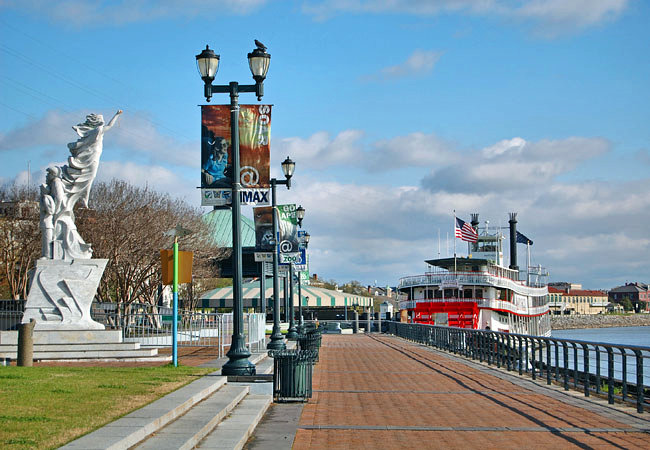
Aquarium/Riverwalk: Located at the foot of Canal Street, the Aquarium features a 400,000 gallon tank filled with coral reefs, sharks, and other aquatic life that populates the Gulf of Mexico. After touring the exhibits, take a few minutes and watch the sharks and turtles swim by. It’s a cool sight to see and well worth your time. The aquarium also has a stingray touch pool, sea otters, and a replica Amazon rainforest. Additionally you can walk along the Riverwalk to get to the Aquarium and watch the ships sail past the city. 

Jackson Square: If you’re in the French Quarter it’s impossible not to walk around Jackson Square at some point. The square is named for Andrew Jackson, who famously defended New Orleans from the English during the War of 1812 (even though the battle took place in Chalmette and the war had ended two weeks earlier). At almost any time of day, you'll see artists selling their wares and there will be a band or two playing in front of the St. Louis Cathedral. If you want a great view of the river and the Square go across Decatur Street and climb to the stairs to the top of the little platform. It's a great place to snap a picture and enjoy the view.

The World War Two Museum 

World War 2 Museum: During World War II, New Orleans was the home of the construction of the "Higgins Boat" an amphibious landing craft used in the Atlantic and the Pacific. Thanks to the efforts of Stephen Ambrose, the popular historian and University of New Orleans professor, and New Orleans business leaders, the museum, located in the Central Business District, opened in 2000 as a way to celebrate and study American involvement in World War 2. It is a must-visit for anyone interested learning more about this crucial period in American history. Read more about the museum here. 

Mardi Gras World: Since 1947, the folks at Mardi Gras World have designed and built the oldest and biggest floats for every Mardi Gras season. Each year they build and decorate over 500 of them. The museum offers tours that include a history of Mardi Gras in New Orleans and then take visitors to see the entire construction process. The museum is open year round as Mardi Gras in New Orleans never stops. 

The white alligator 

Audubon Nature Institute: The Audubon Nature Institute includes a variety of museums and facilities including the Aquarium of the Americas (discussed above), as well as Audubon Park and Audubon Zoo. Located uptown--away from the Quarter and other tourist areas, Audubon Park has over 1.8 miles of jogging paths, ancient live oak trees, picnic areas, and playgrounds. The Zoo, located within a section of the park, houses over 2,000 animals including gorillas, oranguatans, and a rare white alligator with blue eyes. 

Cemetery/Swamp Tours: Due to its low elevation, New Orleans cemeteries are unique in that they generally bury their bodies above ground. Inside the famed St. Louis Cemetery you can find the tomb of Marie Laveau, a famed 19th century Voodoo priestess. You can also see the future tomb of actor Nicholas Cage. If cemeteries aren't your thing, then try a swamp tour. A number of different companies offer tours of the famed Louisiana bayous. Riding in a swamp boat or even an airboat. You'll get to see cypress tress covered in Spanish moss, alligators, pelicans, and other wildlife unique to southern Louisiana.